Synthetic dataset generation
Generate, filter, deduplicate, review, and publish synthetic records.
define schema and policygenerate batch Agenerate batch Bgenerate batch Nfilterdeduplicatequality reviewpublish dataset
Activity responsibilities
| Activity | Responsibility |
|---|---|
define-schema-and-policy | Execute the define schema and policy stage and publish its declared outputs for downstream activities. |
generate-batch-a | Execute the generate batch A stage and publish its declared outputs for downstream activities. |
generate-batch-b | Execute the generate batch B stage and publish its declared outputs for downstream activities. |
generate-batch-n | Execute the generate batch N stage and publish its declared outputs for downstream activities. |
filter | Execute the filter stage and publish its declared outputs for downstream activities. |
deduplicate | Execute the deduplicate stage and publish its declared outputs for downstream activities. |
quality-review | Execute the quality review stage and publish its declared outputs for downstream activities. |
publish-dataset | Execute the publish dataset stage and publish its declared outputs for downstream activities. |
Inputs
- Schema and policy
- Source examples
- Generator model
Outputs
- Raw batches
- Validated dataset
- Quality report
Provenance to preserve
- Prompt and model
- Filter reasons
- Review decisions
Runnable example
This is the complete checked-in bundle for this pattern. Download the environment, scope, topology, workflow, input, container recipe, runner, and validation contract from this page before executing it.
Verified local execution
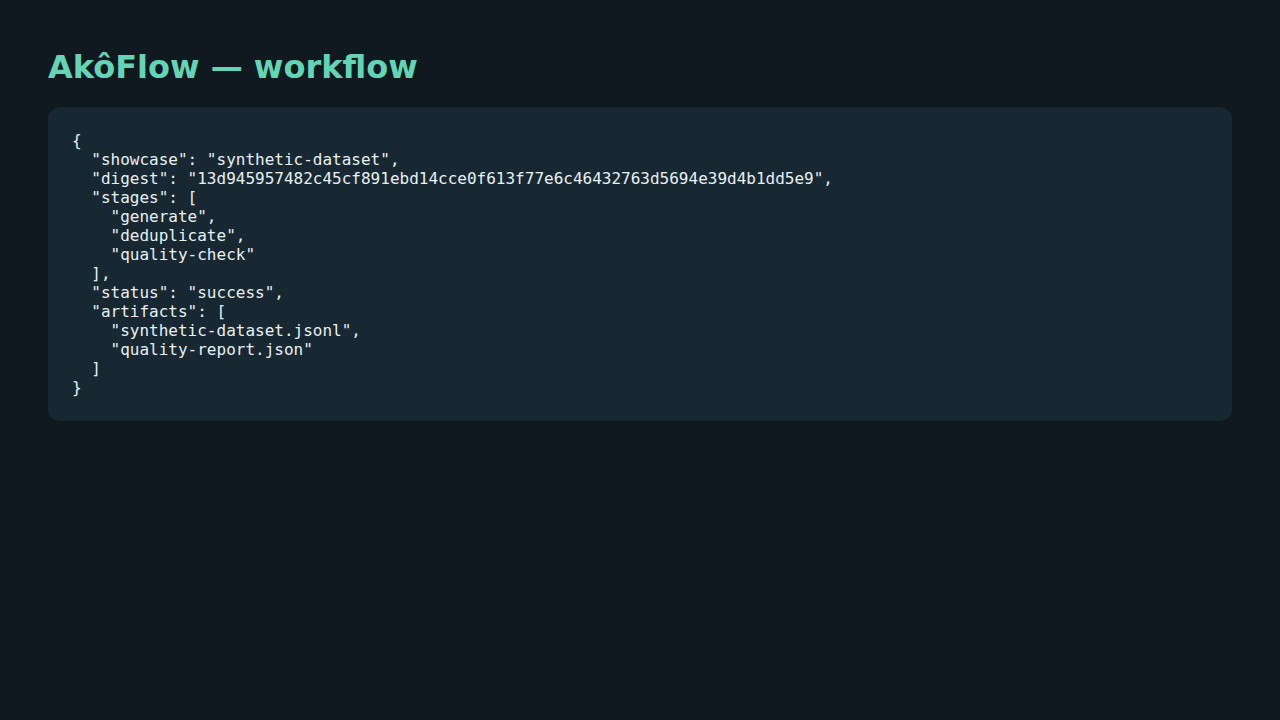
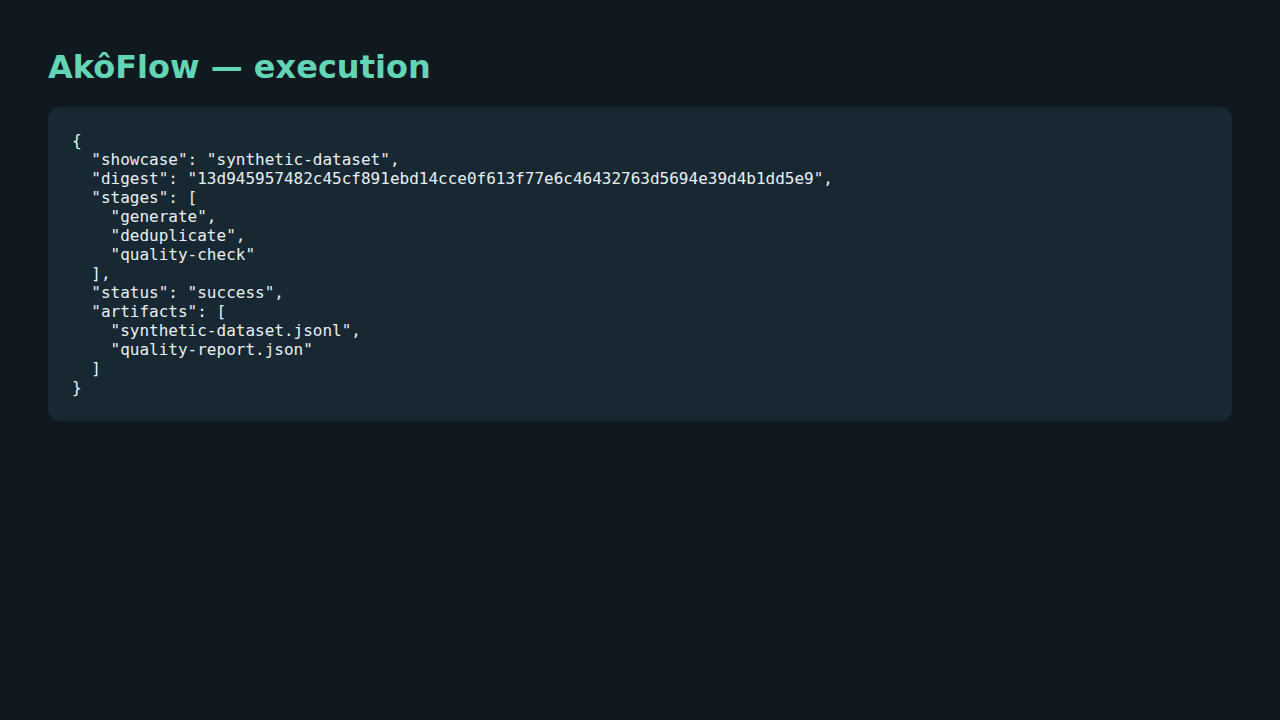
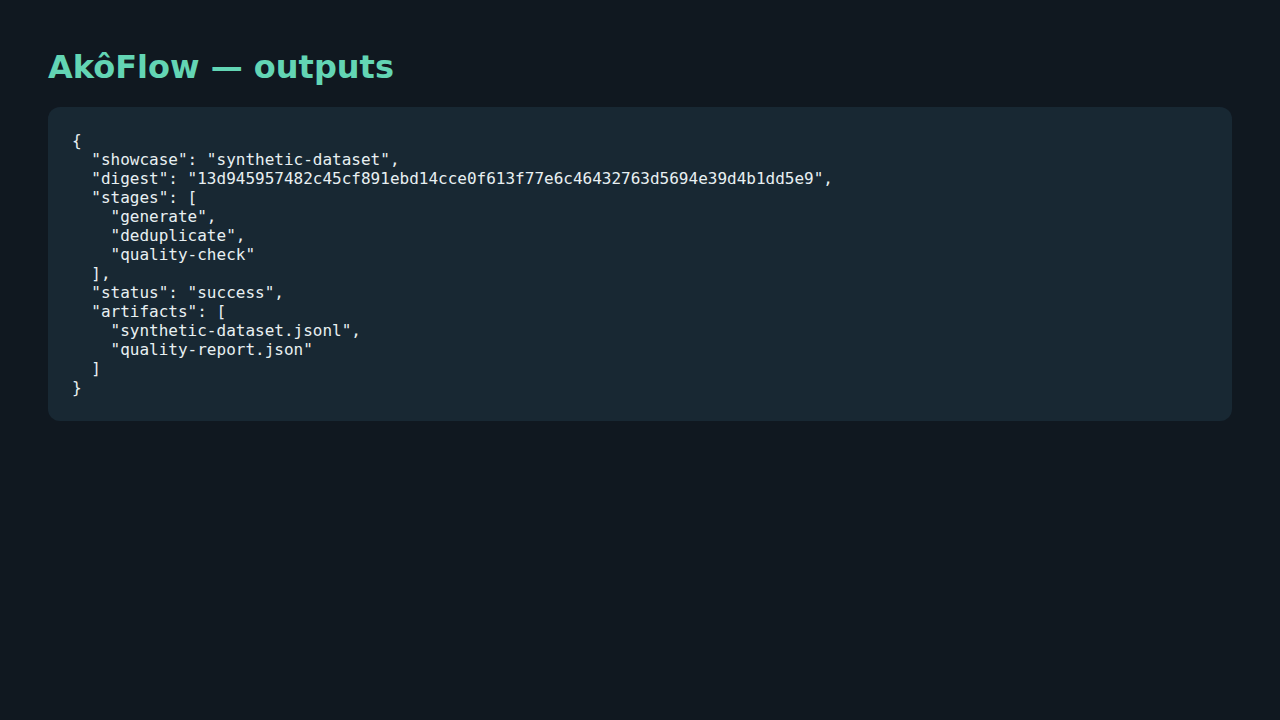
These captures and the output manifest were produced by the fixture's local Docker run and validator. They are published with the same bundle as the runnable files.
Execution considerations
Use queued external jobs for rate-limited generation. Stable record identities prevent duplicates after retries.
AkôFlow boundary: the engine schedules, deploys, executes, transfers data, and records evidence. The ML or agent framework remains an implementation choice inside each activity.