Model conversion and quantization
Create hardware-specific variants and validate compatibility and quality.
load trained modelexport ONNXexport TorchScriptquantize CPUquantize GPUvalidate outputspublish variants
Activity responsibilities
| Activity | Responsibility |
|---|---|
load-trained-model | Execute the load trained model stage and publish its declared outputs for downstream activities. |
export-onnx | Execute the export ONNX stage and publish its declared outputs for downstream activities. |
export-torchscript | Execute the export TorchScript stage and publish its declared outputs for downstream activities. |
quantize-cpu | Execute the quantize CPU stage and publish its declared outputs for downstream activities. |
quantize-gpu | Execute the quantize GPU stage and publish its declared outputs for downstream activities. |
validate-outputs | Execute the validate outputs stage and publish its declared outputs for downstream activities. |
publish-variants | Execute the publish variants stage and publish its declared outputs for downstream activities. |
Inputs
- Canonical model
- Target formats
- Tolerance policy
Outputs
- Optimized variants
- Compatibility report
- Registry entries
Provenance to preserve
- Converter versions
- Calibration data
- Target hardware
Runnable example
This is the complete checked-in bundle for this pattern. Download the environment, scope, topology, workflow, input, container recipe, runner, and validation contract from this page before executing it.
Verified local execution
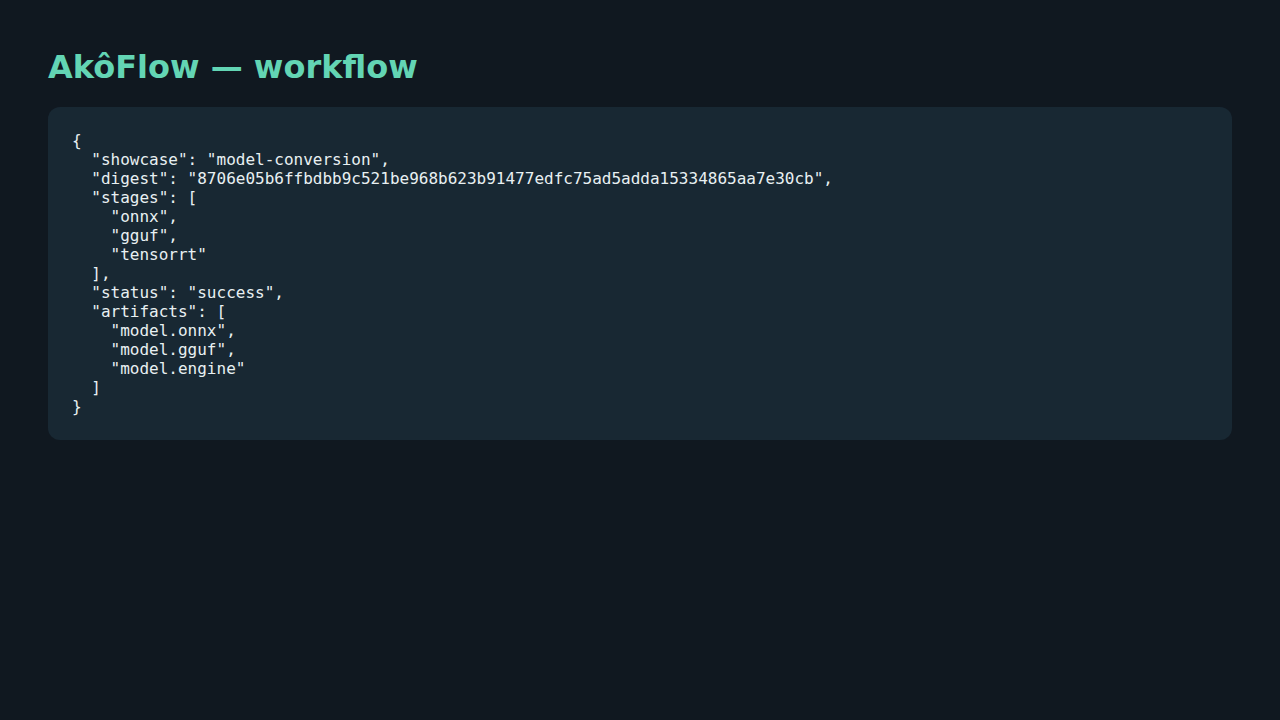
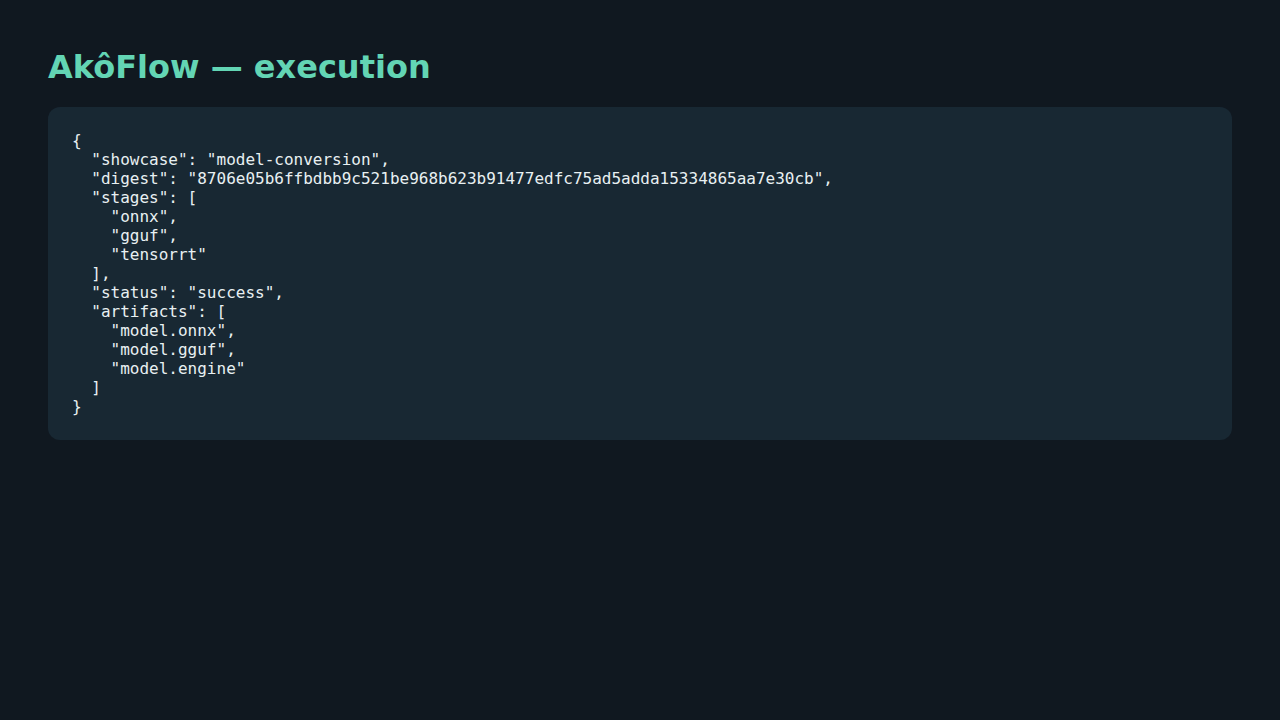
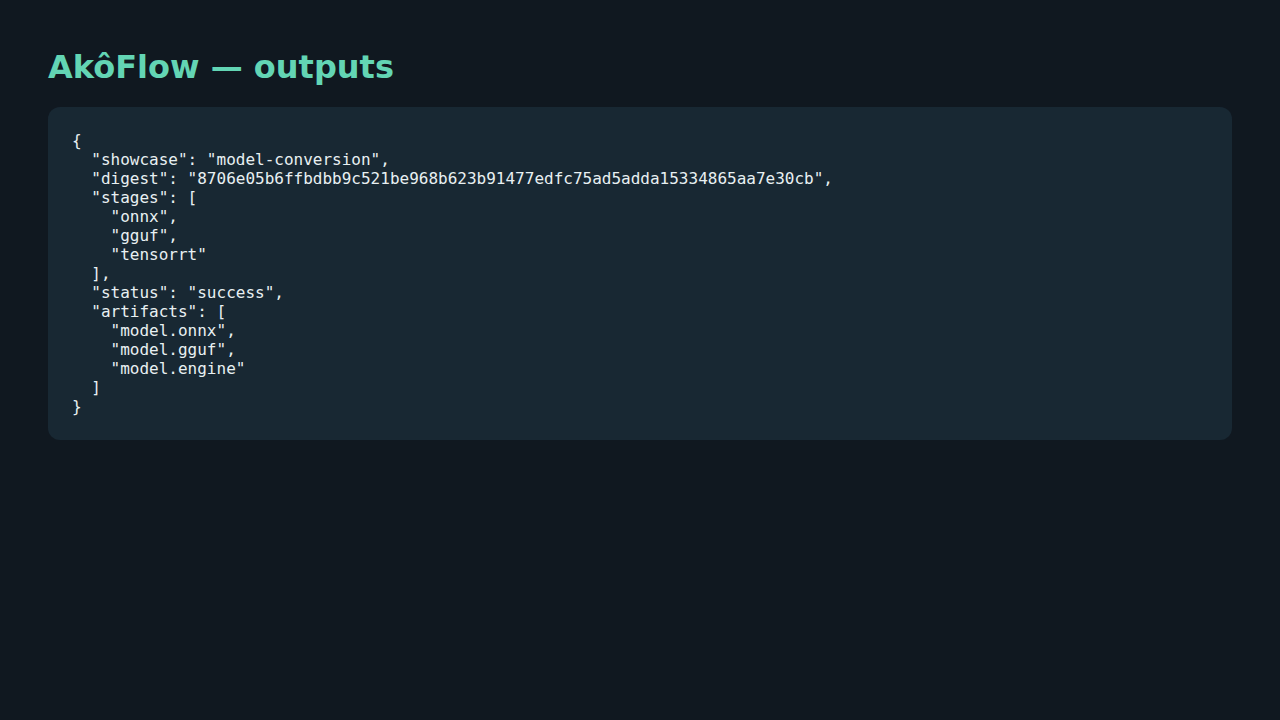
These captures and the output manifest were produced by the fixture's local Docker run and validator. They are published with the same bundle as the runnable files.
Execution considerations
Conversion branches can use different images. Validate optimized artifacts on representative target hardware before publication.
AkôFlow boundary: the engine schedules, deploys, executes, transfers data, and records evidence. The ML or agent framework remains an implementation choice inside each activity.