Data transfer relay
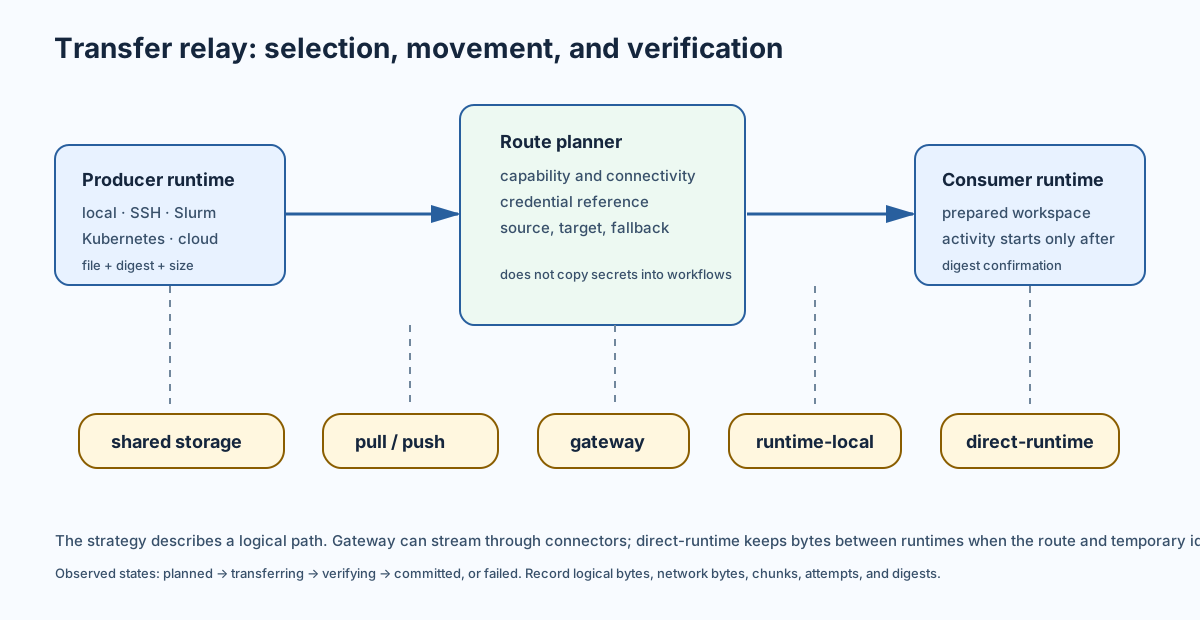
A data transfer relay is the preparation that makes a producer activity's file available in a consumer activity's workspace. A relay is not necessarily an intermediary server: it is the decision and execution of a verifiable route, which can use shared storage, a direct runtime-to-runtime copy, or a connector-mediated path.
Use Network modeling for the planned network cost of a dependency. This page explains how bytes are made available during an actual execution.
Relay model
| Term | Meaning |
|---|---|
| Blob | Bytes identified by an expected digest and size. |
| Location | Where bytes exist, including URI, resource, environment, runtime, connection, and network domain when known. |
| Endpoint | A target a connector can open, write, and commit. Configuration stores credential references, not credential material. |
| Route | The selected strategy, concrete addresses when applicable, selection reason, and fallback. |
| Materialization | Preparing an artifact or workspace at the destination. It is committed only when the verified digest matches the expected digest. |
A dependent activity must not start merely because a copy was requested. Preparation progresses through planned → transferring → verifying → committed; a failure ends in failed. Execution evidence can also record logical bytes, network bytes, completed chunks, attempts, and verified digests.
Strategies
| Strategy | Use it when | It avoids or requires |
|---|---|---|
use-existing | The destination already has the verified version and digest. | Avoids a new copy; availability must still be valid. |
shared-storage | Producer and consumer can see the same PVC, NFS, or scratch path. | Avoids duplication; confirm visibility from the node that will execute the activity. |
destination-pull | The destination can fetch HTTP, S3-compatible, or another exposed endpoint. | Avoids inbound access at the producer; requires valid egress, URL, and destination credentials. |
source-push | The source can publish to the destination. | Avoids consumer egress; requires write permission and destination authentication. |
gateway | No safe direct path is available; connectors read the source and write the destination. | Crosses domains while measuring and verifying the transfer. |
runtime-local | Both activities run on the same concrete instance. | Avoids a network copy; it applies to one instance, not merely to one cloud provider. |
direct-runtime | Two concrete runtimes can exchange bytes directly. | Avoids an intermediary payload hop; requires a verified private route and restricted temporary identity. |
Runtime-specific paths
Local
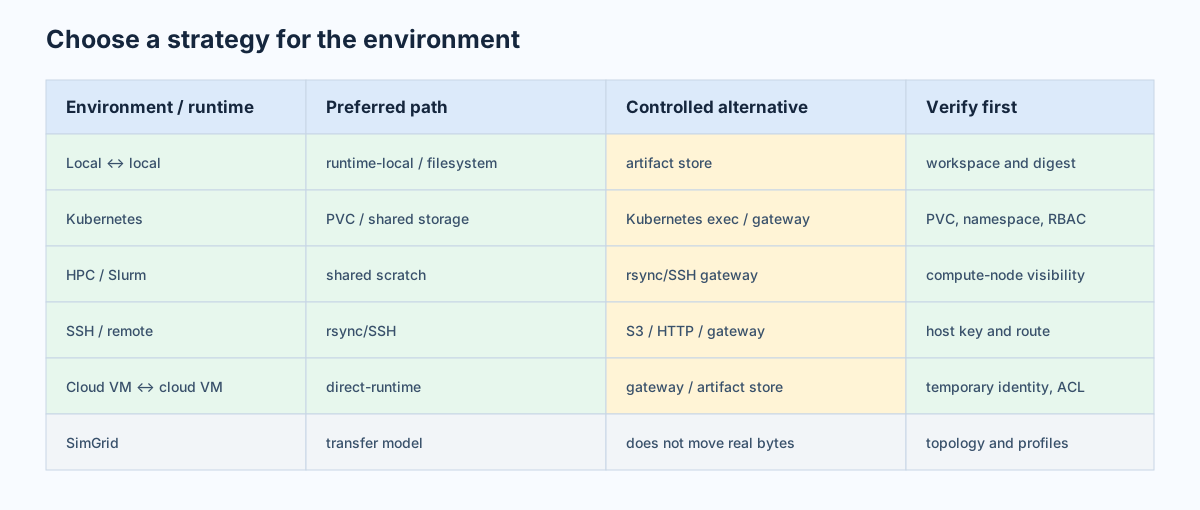
For processes on the daemon host, prefer runtime-local or filesystem access when the workspace is the same. The local runtime is not a sandbox: it runs trusted processes on the host. Move data to a different machine through an explicit remote route, not by assuming local paths are shared.
Kubernetes
For Pods using the same PVC, shared-storage is the simplest route. Confirm the claim, namespace, permissions, and Job mount before selecting it. When data enters or leaves the cluster, Kubernetes exec can participate in a gateway route; this requires API access and appropriate RBAC.
HPC and Slurm
On HPC, visibility from the login node does not establish that a compute node can read or write the same path. Prefer shared scratch only after a compute-node visibility probe. To cross the cluster boundary, use rsync/SSH as a gateway with a restricted account, verified host key, and enough temporary space. sbatch submission and data transfer are separate operations.
SSH and remote hosts
The current SSH runtime executes Docker directly on a remote host; it is not a general remote-shell runtime. rsync/SSH is appropriate when both endpoints have verified paths and identities. For a direct-runtime copy between VMs, AkôFlow uses a short-lived destination identity and does not forward the platform's permanent key.
On-demand cloud
Cloud capacity becomes a runtime only after lifecycle actions create and register a concrete instance. Use runtime-local only inside that same instance. Between VMs, direct-runtime can reduce hops and cost when private networking, ACLs, and a temporary identity are available; otherwise use gateway or an artifact store. Do not put credentials, project IDs, or broad firewall rules in a workflow.
SimGrid
SimGrid models transfers, latency, topology, and cost; it does not move real bytes. Use it to compare plans and validate a network model. A simulated execution does not prove PVC, SSH, S3, Kubernetes API, or cloud access.
Connectors and current limitations
Implemented connectors include the artifact store, local filesystem, rsync/SSH, Kubernetes exec, HTTP download, and S3-compatible transfer. The GCS connector currently rejects direct gs:// transfer; a deployment needs another supported route or its own transfer agent. Configure a fallback rather than assuming a GCS URI will work.
Safe operating sequence
- Identify where the blob exists and where the consumer will actually run.
- Verify fresh capabilities: connector, HTTPS egress, checksum, path, capacity, and execution-node visibility.
- Choose the least invasive route: existing, shared, direct, pull/push, then gateway.
- Restrict identity and network access to the smallest necessary scope; use environment credential references.
- Wait for digest verification and inspect transfer records before attributing a failure to the consumer activity.