Register an HPC / SLURM environment
This tutorial registers an existing institutional HPC account in AkôFlow. It does not create an account at the institution or allocate compute time. Ask the cluster administrator for your login, permitted partition, SSH access policy, gateway requirements, and a shared workspace before starting.
The result is a saved environment with a healthy connection and reviewed inventory. Running the first batch job is a separate step after registration.
Before you begin
- Complete installation and its result checks.
- Obtain the login hostname, SSH user and port, SLURM partition, and gateway command when required. The AkôFlow daemon must be able to reach that route.
- Obtain authorization to use a managed SSH key and verify the site's host-key trust requirements with your administrator.
- Confirm
sinfo,sbatch,squeue,sacct, andscancelare available to your account. Review the HPC operator guide for account/QoS, storage and container-runtime requirements.
login.example.org, researcher, and cpu below are placeholders. Replace them
with the values provided by your institution.
Through the interface
1. Register an SSH service key
Open Settings → SSH service keys. Under Register a service key, enter
research-hpc and choose Generate key. Copy the public key and have it
authorized for your account on the login host and required gateways. If the
institution requires an existing key, use the separate import action described
in Credentials and SSH.
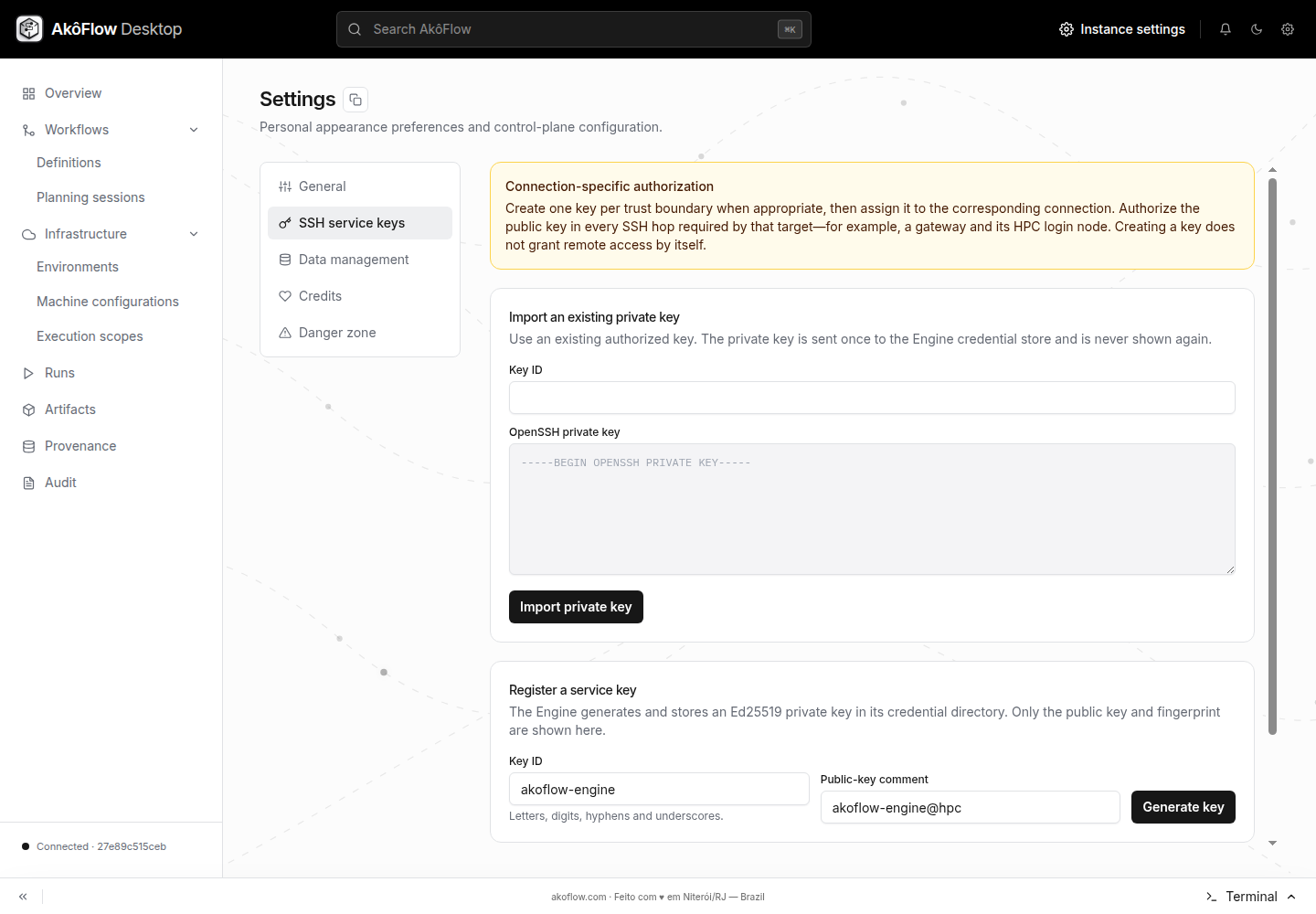
Choose the gear icon labeled Settings, then the SSH service keys tab. This capture shows the empty key catalog before generation.
Generating a key in AkôFlow does not grant access to the cluster.
2. Fill in the HPC connection
Open Infrastructure → Environments → Connect environment and select HPC / Slurm.
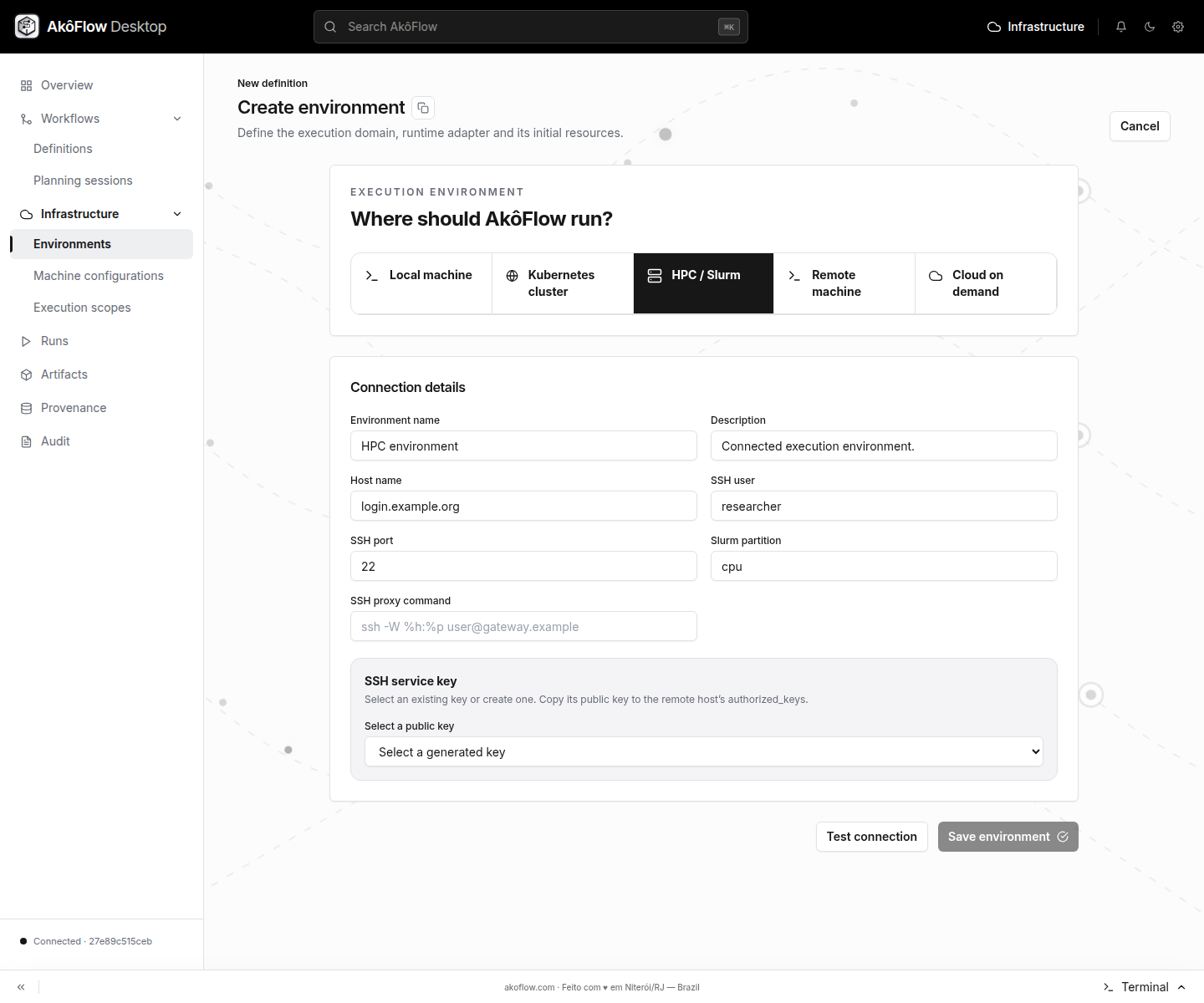
Captured from the official v1.0.8 Linux application through Chromium DevTools, 2026-09-12. Host, user and partition are illustrative values; no remote connection is claimed.
| Field | Enter |
|---|---|
| Environment name | A recognizable name, such as Research HPC |
| Host name | Login hostname only, such as login.example.org |
| SSH user | Your institutional login |
| SSH port | 22, unless the administrator specifies another port |
| Slurm partition | The permitted partition name, such as cpu |
| SSH proxy command | Leave empty for a direct route, or enter the site-approved gateway command |
| Select a public key | The service key you just authorized |
3. Test before saving
Choose Test connection. Wait for Connection verified; Save environment remains disabled until the test succeeds. If you change a connection field, test again. A successful SSH session on your laptop is not sufficient: this test runs from the daemon's host.
Choose Save environment, then open the saved environment. In its connection section, run Check now and Discover. Review Inventory for the expected cluster partitions and compute nodes; see the detailed discovery checks.
Through the API
Complete API connection setup. Use the same approved host, account and partition as in the graphical path.
1. Generate and authorize the key
curl --fail-with-body \
  -H "Authorization: Bearer $AKOFLOW_API_TOKEN" \
  -H 'Content-Type: application/json' \
  -d '{"id":"research-hpc","comment":"Akoflow research HPC"}' \
  "$AKOFLOW_API_URL/ssh-keys/" -o hpc-key.json

jq '{id, publicKey, fingerprint}' hpc-key.json
Authorize the returned publicKey through your institution's procedure before
continuing. Keep the returned credentialRef; do not invent a private-key path.
2. Prepare the environment and test its connection
Download the HPC environment template
and save it as hpc-environment.template.json. This is a complete registration
envelope with an empty inventory; discovery supplies actual cluster resources.
AKOFLOW_HPC_REF=$(jq -er '.credentialRef' hpc-key.json) || exit 1
jq --arg ref "$AKOFLOW_HPC_REF" \
  --arg host 'login.example.org' \
  --arg user 'researcher' \
  --arg partition 'cpu' \
  '.connections[0].credentialRef=$ref |
   .connections[0].endpoint=$host |
   .connections[0].username=$user |
   .connections[0].configuration.partition=$partition |
   .runtimes[0].configuration.partition=$partition' \
  hpc-environment.template.json > hpc-environment.json
Edit configuration.port and configuration.proxyCommand in the connection
when your site requires them. Read the operator guide for host-key configuration.
Then test the exact connection you intend to save:
jq '.connections[0]' hpc-environment.json > hpc-connection.json
curl --fail-with-body \
  -H "Authorization: Bearer $AKOFLOW_API_TOKEN" \
  -H 'Content-Type: application/json' \
  --data-binary @hpc-connection.json \
  "$AKOFLOW_API_URL/connection-tests/" -o hpc-test.json
jq . hpc-test.json
jq -e '.healthy == true' hpc-test.json
Continue only if the last command succeeds. An HTTP response alone does not
prove the connection is healthy; read its message if the test fails.
3. Save, inspect health and discover inventory
curl --fail-with-body \
  -H "Authorization: Bearer $AKOFLOW_API_TOKEN" \
  -H 'Content-Type: application/json' \
  --data-binary @hpc-environment.json \
  "$AKOFLOW_API_URL/environments/" | jq

curl --fail-with-body -X POST \
  -H "Authorization: Bearer $AKOFLOW_API_TOKEN" \
  "$AKOFLOW_API_URL/environment-connections/research-hpc-connection/health/" | jq

curl --fail-with-body -X POST \
  -H "Authorization: Bearer $AKOFLOW_API_TOKEN" \
  "$AKOFLOW_API_URL/environment-connections/research-hpc-connection/discover/" | jq

curl --fail-with-body \
  -H "Authorization: Bearer $AKOFLOW_API_TOKEN" \
  "$AKOFLOW_API_URL/environments/research-hpc/" \
  | jq '{environment: .environment.id, version: .version.id,
         resources: [.resources[] | {id, type, providerId, schedulable}]}'
Inspect the health result before running discovery. Keep the environment version returned by the server when creating an execution scope.
Verify the registration result
| Evidence | Expected result |
|---|---|
| Saved environment | research-hpc appears in the environment catalog |
| SSH health | Healthy from the daemon using the selected credential and route |
| Discovery | Expected partitions/nodes appear with plausible capacity |
| Compute boundary | The login host is not treated as a batch compute allocation |
| Shared workspace | Site-provided path is accessible from an approved compute allocation |
A discovered partition is not a reservation. Registration does not prove that an account, QoS, container image or shared filesystem will work in a batch job. Continue with scope setup and a small real execution.
If registration fails
| Symptom | Next action |
|---|---|
| No service key in the selector | Generate/import the key, then reopen the form |
| Connection test fails | Read its message; verify host, user, key authorization and gateway from the daemon |
| Saved environment has no partitions | Run discovery and check sinfo availability and connection history |
| Resources exist but jobs remain queued | Review partition/account/QoS with the administrator |
The screenshots and payload structure were checked against the local interface and handlers. Remote SSH, discovery and a real batch submission require your institution's access and were not performed for this tutorial's capture.
Next: connect Google Cloud when you also need cloud capacity.